
If you’ve been following my weekly and monthly updates over the past few months, you probably noticed a recurring theme: the weather.
This winter brought one of the coldest and snowiest stretches New York has seen in years. Snowstorms and freezing temperatures periodically slowed showings and delayed listings from coming to market.
At the same time, mortgage rates moved lower throughout much of the season, briefly dipping below 6% in late February for the first time in three years, improving affordability and shifting the rent-versus-buy equation in favor of ownership for some households.
However, that trend reversed quickly as the winter season came to a close. As conflict in Iran and the broader Middle East intensified, mortgage rates rose sharply, climbing back to levels last seen before Labor Day last year in just a few weeks.
Yet despite the challenging weather conditions and shifting financial backdrop, the housing market across both Manhattan and Brooklyn remained surprisingly resilient.
If there was one defining theme of the winter market, it was this: buyers stayed engaged while many sellers chose to wait.
That dynamic quietly tightened inventory across the city and helps explain why the market has often felt more competitive than the raw numbers might suggest.
For the purpose of this analysis, I define the winter market as running from the week of Thanksgiving through the second week of March.
Manhattan: Supply Fell Faster Than Demand
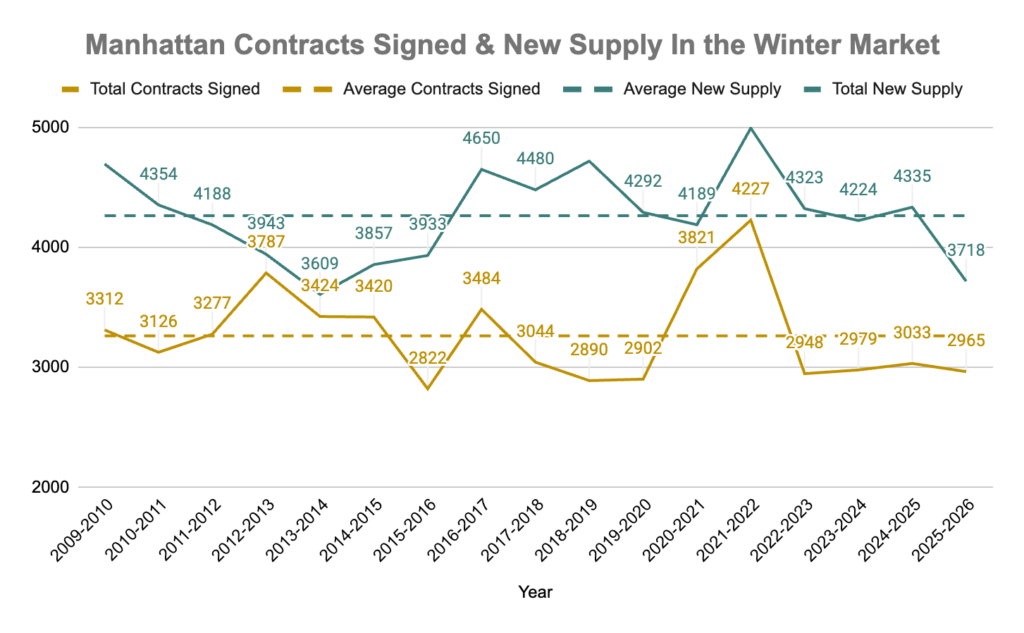
In Manhattan, 2,965 contracts were signed this winter, slightly below the long-term seasonal average of 3,262 contracts.
That represents only a 2% decline compared with last winter, when 3,033 contracts were signed.
On the supply side, however, the pullback from sellers was much more noticeable.
Only 3,718 new listings came to market, down from 4,335 last winter, representing a 14% year-over-year decline.
Taken together:
- Contract activity declined modestly
- New-to-market supply declined significantly
This imbalance meant inventory tightened faster than buyer demand softened.
That gap between supply and demand is the key reason many buyers experienced the market as competitive throughout the winter, even though overall activity levels were not unusually high.
Many sellers appeared reluctant to bring properties to market during harsh weather conditions, choosing instead to wait for a more favorable moment closer to spring. Buyers, however, largely continued their search, particularly as improving mortgage rates earlier in the season provided some relief on affordability.
The result was a market where competition remained steady simply because fewer homes were available.
Brooklyn: Demand Stayed Close to Normal Levels
Brooklyn experienced many of the same dynamics, though the pattern looked slightly different.
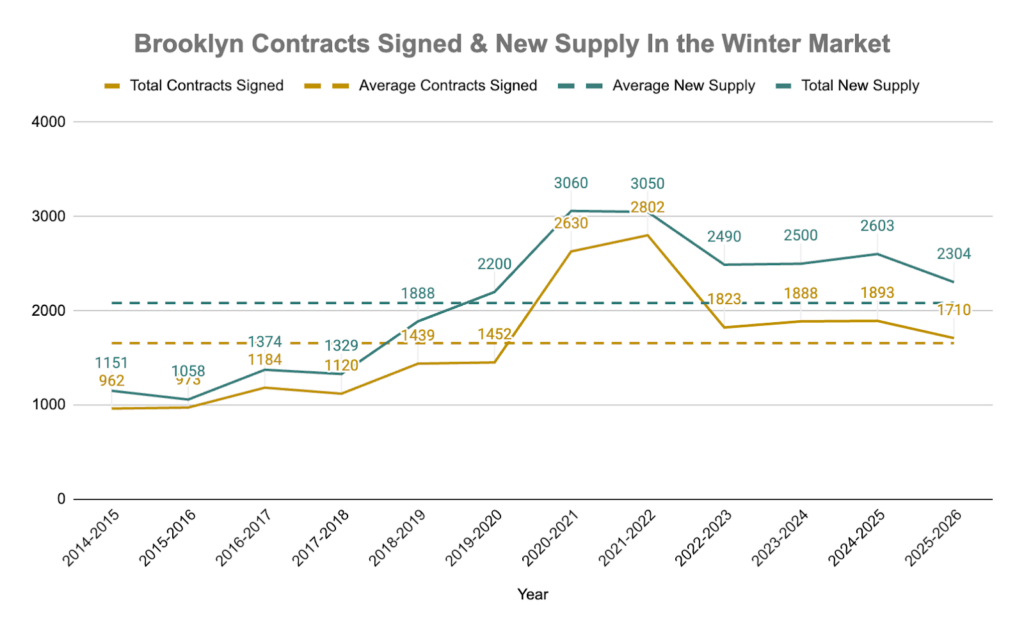
During the winter season, 1,710 contracts were signed, compared with 1,893 contracts signed last winter, representing a 10% year-over-year decline.
At the same time, 2,304 new listings came to market, down from 2,603 listings last winter, a decline of roughly 11%.
In other words, both supply and demand softened at roughly the same pace.
Even so, Brooklyn’s contract activity remained slightly above the borough’s long-term winter average of 1,656 contracts, reinforcing the idea that buyer demand remained remarkably steady.
Much of Brooklyn’s inventory also arrived later in the winter season, after several disruptive storms temporarily slowed listings earlier in the period.
That timing created weeks in which buyers competed for a relatively limited pool of available homes, helping sustain pricing and reinforcing the sense that desirable properties continued to attract strong interest.
Taken together, the data from both boroughs point to the same conclusion: inventory tightened more than demand weakened this winter, helping explain why the market often felt more competitive than the headline activity numbers might suggest.
What This Means as the Spring Market Begins
With winter now behind us, the market is entering what is traditionally its most active period of the year.
The seasonal momentum we are beginning to see suggests the spring market could be busy, particularly if weather-delayed listings begin arriving alongside steady buyer demand.
Of course, the broader economic backdrop remains complicated.
The improving seasonal momentum is unfolding alongside conflict in Iran and the Middle East, disruptions to oil flows and rising energy prices, stock market volatility, affordability concerns, and a recent sharp increase in mortgage rates.
Earlier in the winter, falling mortgage rates helped bolster buyer confidence and contributed to the steady demand we saw across both Manhattan and Brooklyn.
But as the season ended, that trend reversed quickly.
In just three weeks, mortgage rates climbed back to levels last seen before Labor Day of last year, a rapid shift after briefly reaching a three-year low in late February.
This shift arrives at an important moment. The spring market is typically when the largest number of buyers and sellers enter the market, and small changes in financing conditions can have an outsized impact on activity.
In many ways, winter did not slow the market as much as it temporarily paused the supply side.
The key question now is how quickly inventory returns—and whether buyer demand proves as resilient in the face of higher mortgage rates as it did during the winter season.
Those two forces—returning supply and shifting borrowing costs—will ultimately determine how competitive the New York City housing market becomes as spring unfolds.
Data Sources: Data in this report were sourced from reSOURCE, UrbanDigs, Marketproof Pro, and Mortgage News Daily.
Leave a Reply