
August is typically a transition month for Manhattan real estate. New listing activity slows, existing inventory declines, and many sellers wait until after Labor Day to bring their homes to market.
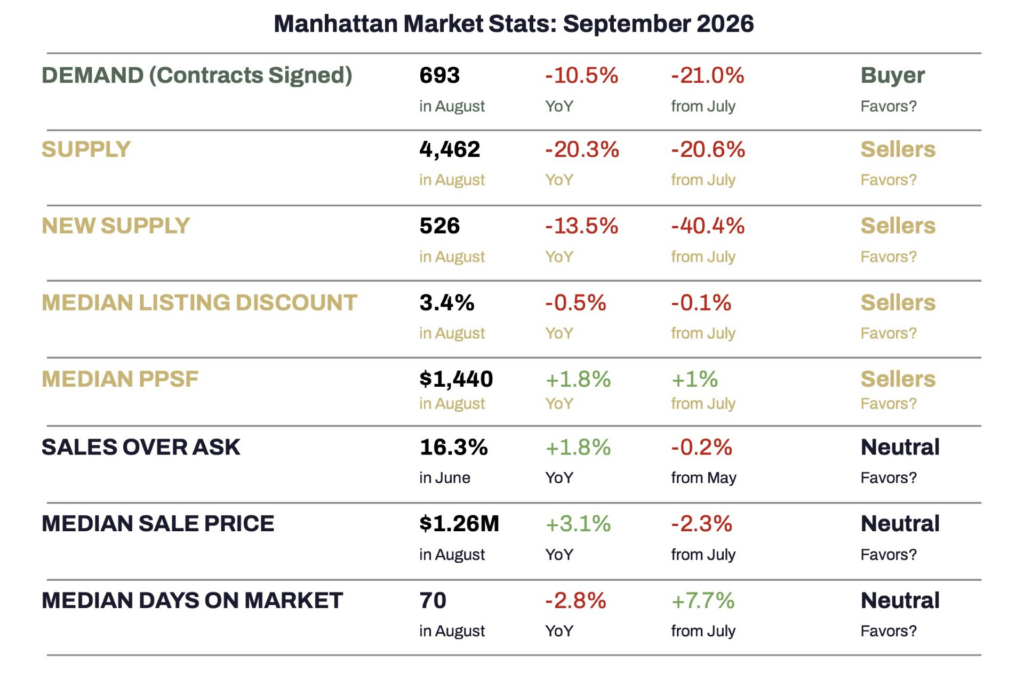
This August followed that seasonal pattern, but to an unusual degree. Only 526 new listings came to market in Manhattan, down 13.5% from last year and 40% from July. That was the fewest new listings for any August in the past decade, well below the 10-year August average of 907.
At the same time, 979 properties were taken off the market during August, 4% more than in July. Together, fewer new listings and more properties being removed pushed Manhattan’s active inventory down to just 4,462 homes, approximately 20% below both last year and July.
Part of that decline reflects a genuine shortage of sellers, while part reflects normal August seasonality. This year, another factor also contributed: a significant number of listings were removed from public marketing, with some then moved to the REBNY RLS “Participant Only” status.
The shortage of new inventory was broad-based. Of the 526 properties that came to market in August, 460 were priced below $4 million, down 14% from last year. Just 67 new listings were priced at $4 million and above, down 8%. Both represented the fewest new listings for any August in their respective price ranges over the past decade. That matters because Manhattan was already operating with constrained inventory heading into the summer.
But the headline supply number does not tell the entire story. During August, 342 listings were added to the RLS as Participant Only. (Participant Only listings can be viewed by REBNY members searching within the RLS but are not publicly marketed or distributed to consumer listing portals.)
Of those 342 listings, 325 (95%) came from Compass and its affiliated brands, including Corcoran, Sotheby’s International Realty, and Coldwell Banker Warburg. That concentration is notable. Those brands currently represent approximately 40% of Manhattan’s publicly available for-sale inventory, meaning their share of August’s newly added Participant Only listings was more than twice their overall listing market share.
This aligns with Compass’ publicly discussed fall marketing strategy of removing certain listings from public marketing before relaunching them, in part to create a fresh marketing moment and reset the days-on-market counter. The result is an important distinction for consumers: Manhattan has less inventory, but the publicly visible inventory number has also been temporarily reduced by properties that may still be available within the brokerage community.
And while relaunching a property may reset a days-on-market counter on certain platforms, it does not erase its history. Brokers and consumers can still recognize a property that has previously been on the market. A relaunch can create a new marketing moment, but ultimately the market will continue to judge the property based on its price, condition, location, and competition.
It is also notable that August’s Participant Only activity was not concentrated at any particular end of the market. Approximately 80% of Manhattan’s current publicly marketed inventory is priced below $4 million and 20% is priced at $4 million and above. The Participant Only listings added during August were almost identical in composition: 81% were below $4 million and 19% were $4 million and above.
In other words, at least in August, the use of Participant Only status largely mirrored Manhattan’s existing inventory in terms of price. That is useful context because private or limited marketing is sometimes positioned as a strategy particularly suited to luxury or highly unique properties. August’s data suggests its recent use in Manhattan has been much broader.
Buyers Slowed in August, But Luxury Continued to Outperform
Supply was not the only side of the market that slowed. Manhattan recorded 693 signed contracts in August, down 10.5% from last year and 21% from July. That was 16% below the 10-year August average of 828 and the second-lowest August contract total of the past decade.
Some moderation is expected in August, particularly following an active spring and a July that outperformed. But the breakdown by price point reveals two very different markets.
Below $4 million, 609 contracts were signed, approximately 20% below the long-term August average of 763 and the second-lowest August total of the past decade.
But luxury told a different story. There were 86 contracts signed at $4 million and above, 32% higher than the long-term August average of 65. It was the fourth-strongest August for luxury contract activity in the past decade and roughly in line with activity during the previous two Augusts. That consistency is notable. Manhattan’s luxury market has remained remarkably resilient, with affluent buyers continuing to show a strong appetite for owning a piece of Manhattan.
Pricing Remained Firm
The median sale price increased 3.1% year over year to $1.26 million, while median price per square foot rose 1.8% to $1,440.
The median listing discount was just 3.4%, slightly lower than both last year and July. And while median Days on Market increased 7.7% from July to 70 days, that is not unusual during the summer. More importantly, properties actually spent nearly 3% fewer days on the market than they did last August.
With supply declining faster than demand, prices have remained firm, and there’s renewed upward pressure on prices.
What Happens After Labor Day Will Tell Us More
The fall market traditionally brings a wave of new listings after Labor Day. This year, that wave should include both properties coming to market for the first time and some homes that were removed from public marketing during August and are subsequently relaunched.
Buyer activity should follow, although typically with a lag. Buyers need time to view the new inventory, compare their options, negotiate, and complete due diligence before that activity is reflected in signed-contract statistics. As a result, an increase in September listings may not translate into stronger contract numbers until later in September or October.
The most important question this fall will not simply be how much inventory returns, but how quickly buyers absorb it. The best properties entering the fall market are often the ones that enter contract the quickest. Homes that are thoughtfully priced, well renovated, and located in desirable buildings and neighborhoods are likely to attract attention quickly.
For sellers, the arrival of additional September inventory will also mean more competition. A relaunch alone will not change how the market values a property that buyers have already seen. Pricing and presentation will still matter.
For buyers, the coming weeks should bring something many have been waiting for: more choice.
📌 Data Sources: Data in this report were sourced from RealPlus, UrbanDigs, Marketproof Pro, and Mortgage News Daily.
Leave a Reply