
Manhattan delivered its strongest fall season since 2021—and its second-best in 11 years—with rising demand, stable inventory, and early signs of price firming.
The fall market (which I define as the Tuesday after Labor Day through the Friday before Thanksgiving) tends to follow a familiar seasonal rhythm. New listings come to market in a wave immediately after Labor Day, peak in late September and early October, and then gradually taper as November arrives. Buyers typically start the season by surveying the fresh inventory before contract activity builds through late September, October, and into early November. This year followed that pattern almost perfectly.
Across Manhattan and Brooklyn, the story of Fall 2025 was one of confidence, balance, and renewed momentum. Demand was stronger than expected, supply arrived in steady and orderly waves, and both boroughs showed clear signs of price firming and improving sentiment heading into 2026.
Manhattan: An Above-Average Fall
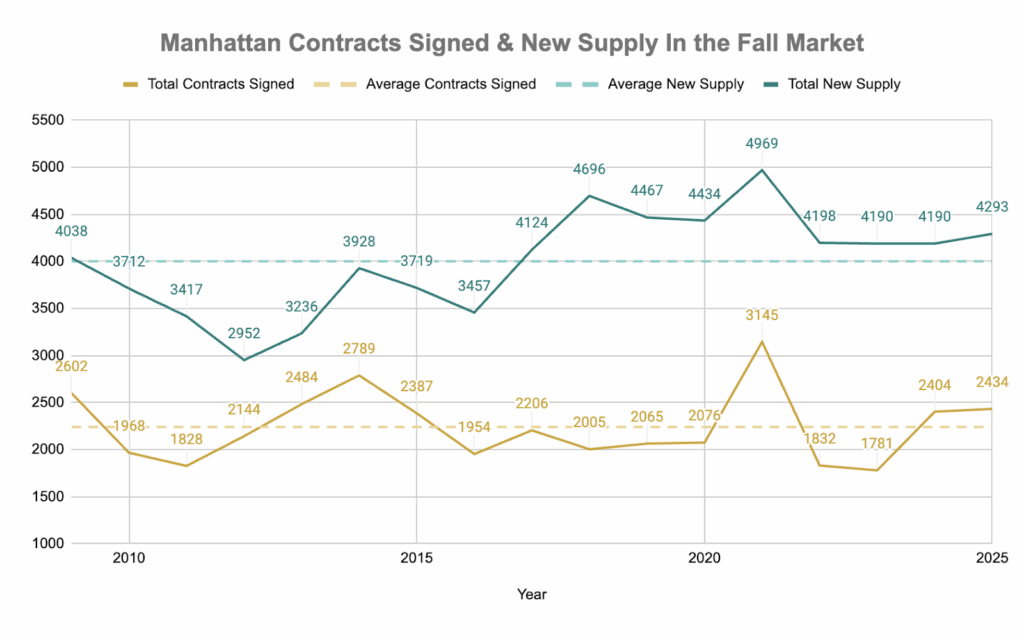
Manhattan posted its strongest fall season since 2021 and its second-best in the last 11 years, with 2,434 contracts signed. That figure sits well above the long-term fall average of approximately 2,240, placing 2025 among the most active and healthy fall markets of the past two decades. Outside of 2021, an anomaly, you’d need to look back to 2013 and 2014 to find a fall season with comparable demand.
New-to-market supply was equally encouraging. Manhattan saw 4,293 new listings, similar to each of the past three fall seasons and slightly above the long-term average. Since 2017, fall supply has stabilized at a higher, but healthy, level versus the tighter 2009–2016 period, when constrained inventory helped fuel rapid appreciation between 2012 and 2015.
Today’s environment reflects something far more sustainable: stable supply with rising demand, the exact pattern that typically precedes steady, durable price growth. This isn’t the fast, sharp run-up of 2011–2014, when falling supply and surging demand created outsized appreciation. Instead, this is the kind of fundamentals-driven setup that supports measured upward pricing pressure and improving leverage for sellers.
The takeaway is clear: Manhattan’s fall market was not just strong by historical standards, it was constructively strong, underpinned by stable inventory, engaged buyers, and firming pricing. It positions the borough well for 2026.
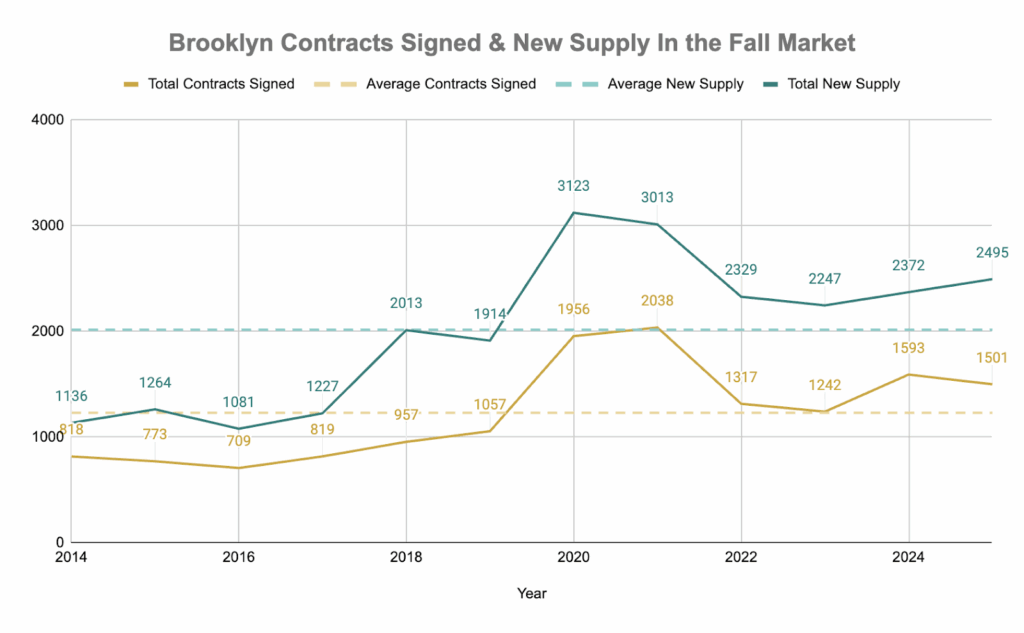
Brooklyn’s fall market, though seeing slightly fewer contracts than last year, still delivered an above-average performance. With 1,501 contracts signed, this was the fourth-highest fall season in the past 12 years, outperforming 2022 and 2023, two years when rising interest rates weighed heavily on activity. This fall’s contract volume was 22% above the 12-year average.
Supply was equally notable. Brooklyn saw nearly 2,500 new listings, the third-highest fall supply total in twelve years and 29% above the long-term average. Inventory levels exceeded each of the past three fall seasons while remaining below the anomaly volumes seen in 2020 and 2021.
Over the last several years, Brooklyn has transitioned from the hyper-competitive conditions of 2020–2021, when buyers absorbed new inventory almost instantly, to a healthier, more balanced market where buyers have more choice, and sellers still benefit from strong baseline demand. Brooklyn’s fall market, like Manhattan’s, sets the stage for a constructive 2026, especially if broader economic clarity improves and interest rates continue to decline.
How Supply and Demand Are Shaping Pricing and Leverage
The relationship between contract activity (demand) and new-to-market supply (inventory) remains one of the clearest indicators of pricing direction and leverage.
From 2011 to 2014, Manhattan experienced rising demand and falling supply, conditions that produced some of the most significant appreciation in the borough.
From 2017 to 2019, supply increased while demand moderated, leading to softer pricing following the 2015–2016 peak.
Today, the market stands in a healthier middle ground: supply has held stable, while demand is now strengthening. This combination rarely produces rapid appreciation, but it typically leads to firmer prices, improved sentiment, and moderate upward pressure on prices. It also reflects an important positive shift in buyer psychology, now that we are again in a declining interest rate environment.
Brooklyn’s pattern mirrors Manhattan’s arc but with different timing. In 2020–2021, heavy supply was absorbed instantly by heightened demand, keeping prices extremely firm. Over the past three years, supply increased while demand normalized, reintroducing modest but healthy negotiability. This fall’s above-average contract activity and higher, but not excessive, new supply reflect a stable market in the borough.
The overarching takeaway: When demand strengthens while supply remains steady, as it did this fall, markets firm, leverage tilts toward sellers, and the foundation is laid for the next appreciation cycle.
So What? What This Means for Buyers and Sellers
Why Buyers Should Pay Attention Now
Across both boroughs, the rent-versus-buy equation is shifting back toward buying. Mortgage rates are declining, while rents continue to rise, especially in the aftermath of the FARE Act.
For buyers with a longer-term holding period, purchasing may now outperform renting, particularly when paired with the potential to take profits from nearly three years of strong market returns and diversify into Manhattan real estate, where prices are roughly the same as they were a decade ago.
Brooklyn presents a similar opportunity. After several years of substantial price growth and limited negotiability, modest negotiability has returned, all while rents remain elevated.
This winter presents an especially attractive window for buyers. Demand is often seasonally lighter, and some listings that lingered through the fall, especially those with price reductions, may have motivated sellers. Buyers who act before the spring wave of new listings and renewed buyer competition may find good values.
Why Sellers Have a Constructive Setup
Sellers should feel encouraged, but they must remain realistic. Buyers are active and engaged, but they are selective. Turnkey homes with beautiful renovations, efficient layouts, great light, and in prime locations continue to command premium pricing. These homes remain highly attractive to buyers who value move-in-ready quality and want to avoid today’s longer, more expensive renovation timelines.
For sellers of homes needing work, or properties that are oversized or undersized for their bedroom count, competitive pricing remains essential. Renovations today are more costly and time-consuming, putting downward pressure on homes that require significant work. Still, some of the best-value opportunities in the market are co-ops in need of renovation, where buyers can create value and later realize potentially meaningful gains.
For sellers who are not in a rush, waiting until the spring or next fall, when buyer activity typically accelerates, could yield even better outcomes, especially if mortgage rates continue to decline.
But timing the market perfectly is impossible. The most important factor remains personal circumstances. In today’s more normalized, cyclical environment, buyers and sellers are no longer acting out of FOMO; they are acting based on real-life events and the enduring five D’s of real estate: diamonds, diapers, divorce, death, and downsizing.
Bottom Line
Fall 2025 was a healthy, active, and confidence-building season. Manhattan delivered one of its best fall markets in more than a decade, and Brooklyn outperformed its long-term average. Supply arrived in predictable, orderly waves; demand strengthened across both boroughs; and pricing showed clear signs of firmness.
This was not a market defined by volatility or uncertainty, quite the opposite. It was defined by balance, resilience, and constructive momentum, with both buyers and sellers acting thoughtfully and strategically.
If mortgage rates continue to ease and/or broader economic clarity improves, Manhattan and Brooklyn both have the foundation for a strong 2026. Sentiment is improving, activity is rising, and the underlying dynamics point toward a market that is not just stable, but well-positioned for the next phase of growth.
Data Sources: Data in this report were sourced from ReSOURCE, UrbanDigs, and Marketproof Pro
Leave a Reply