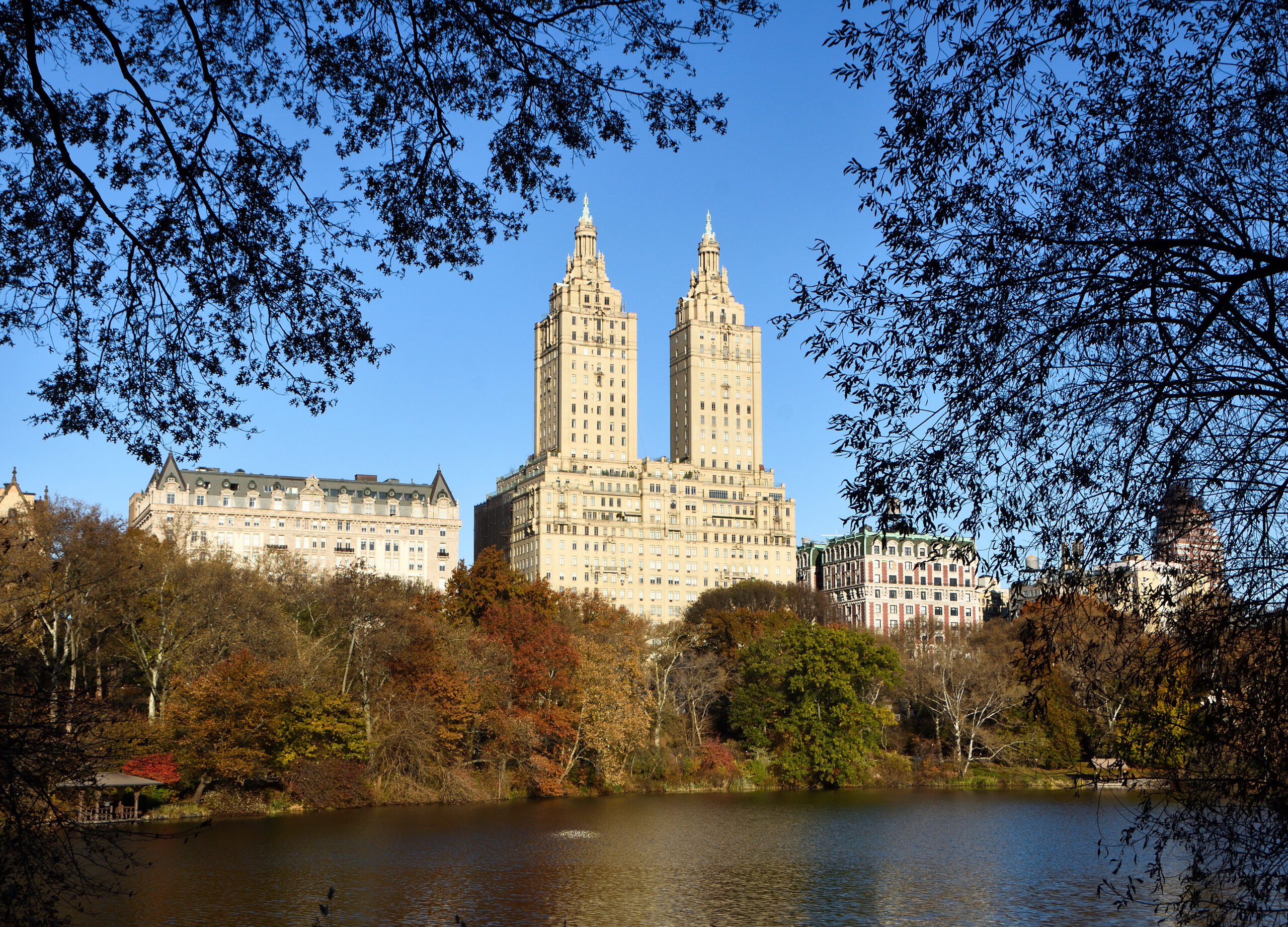
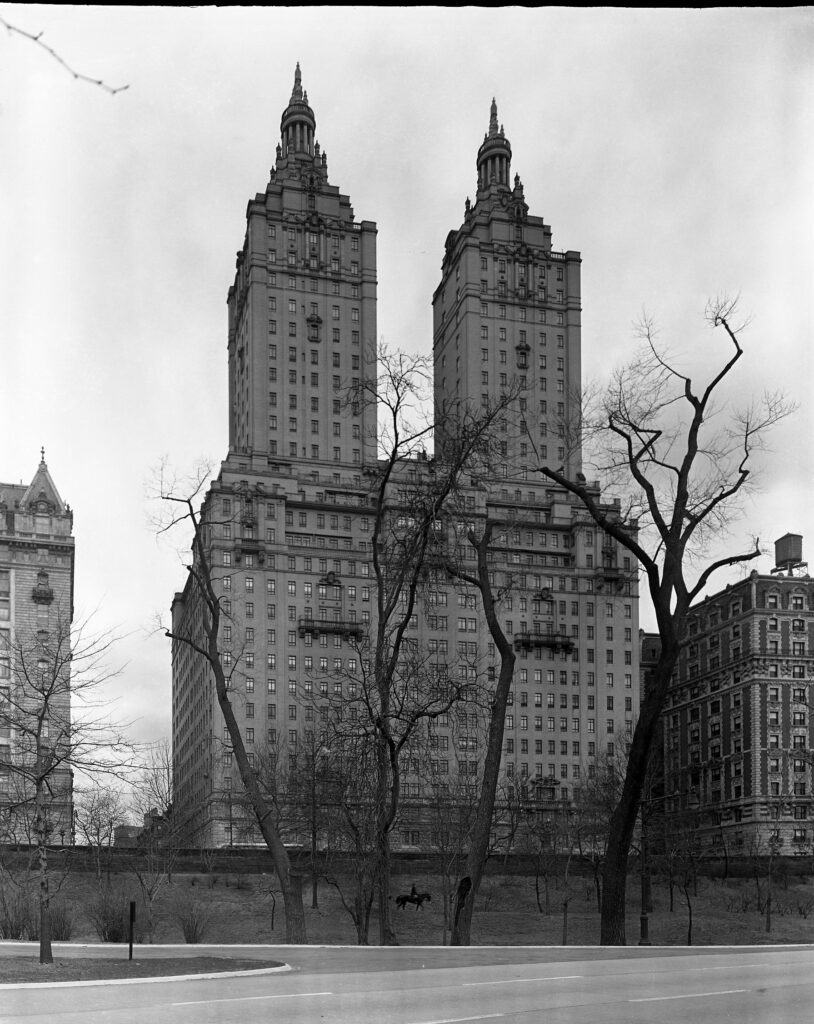
The San Remo in 1942, from the collection of the Office for Metropolitan History.
The San Remo was designed by famous New York City apartment architect Emery Roth in 1929 and finished in 1930. It benefited from a law passed in the spring of 1929 that permitted high towers on plots greater than 30,000 square feet. It was the first of the four twin-tower buildings to define Central Park West’s distinctive skyline, followed by the Century at 62nd Street, the Majestic at 72nd Street, and the Eldorado at 90th Street.
The dual towers and height of the building were considered very modern at the time of the building’s construction. Roth balanced the modern form with classical details, inspired by the late Italian Renaissance.
Shortly after the San Remo’s construction, the Depression ended such lavish projects for Roth. When he designed the Normandy in 1938, at 86th Street and Riverside Drive, it had significantly smaller apartments than the San Remo and no towers in its design. Apparently, the market for such expensive construction had vanished.
The San Remo is now considered a celebrity building, and telephone listings from the 1930s indicate that it housed prominent show businesspeople in its early years as well. They included Albert Warner, one of the Warner Brothers; Joseph Vogel, vice president of Loew’s; and Eddie Cantor, the comedian and singer. Cantor, named Isidor Iskowitch when he was born in 1892 into a tough life on Eldridge Street on the Lower East Side, made his way into vaudeville in the 1910s, and became a favorite of Florenz Ziegfeld and other producers.
The San Remo went on to welcome other entertainer residents like Mary Tyler Moore, Barry Manilow, Bruce Willis, Demi Moore, Diane Keaton, and Dustin Hoffman. (However, in 1985, Madonna was rejected by its board.) Local architectural celebrities like Paul Goldberger, architectural critic for The New Yorker, and César Pelli, architect of the World Financial Center downtown, have also called the San Remo home.
More About Us: The Office for Metropolitan History (MetroHistory) is pleased to offer its services to Brown Harris Stevens brokers working with pre-war buildings. Founded in 1975 by the late architectural historian and New York Times columnist Christopher Gray, MetroHistory has long been recognized as New York City’s premier specialist in building research and document recovery. For research inquiries, please reach out directly to Sam Hightower, Director, Research@MetroHistory.com, (212) 799-0520.
Services Available
- Drawing Recovery: Locating original architectural, structural, and mechanical drawings.
- Historic Photographs: Access to a collection of 40,000 negatives and 18,000 photographs.
- Literature Review: Comprehensive review of architectural periodicals, historic newspapers, brochures, deeds, and other archival material.
- Building Reports: Synthesis of the literature review into a compelling story. Can be targeted for more specialized technical and legal needs.
When To Call Us
- Renovation Needs: When clients want to blow out the wall between the living and dining rooms, we will find the blueprints that actually tell them what they need to know: where the beams, columns, and risers are.
- Marketing Premier Listings: Add credibility and historic gravitas to your promotional material with original drawings, old photographs, and property history.
- Client Gifts: There is no more perfect gift for the proud new owner of a pre-war apartment than a historic photograph or drawing elegantly framed.
- Centennial Celebrations: For their upcoming centennials, boards of pre-war apartment buildings can engage our services to learn more about the history of their buildings and prepare for their next hundred years.
Click here to learn more about the Office for Metropolitan History
Leave a Reply