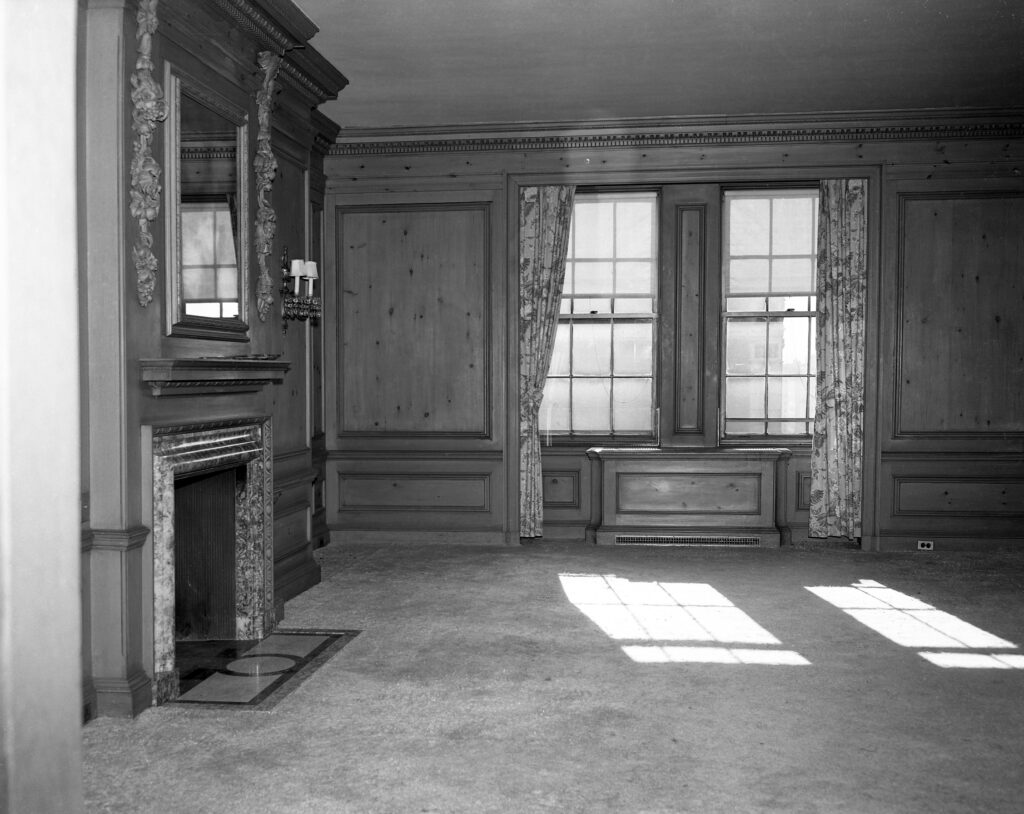
1955 interior view of an apartment in 1021 Park Avenue, from the collection of MetroHistory
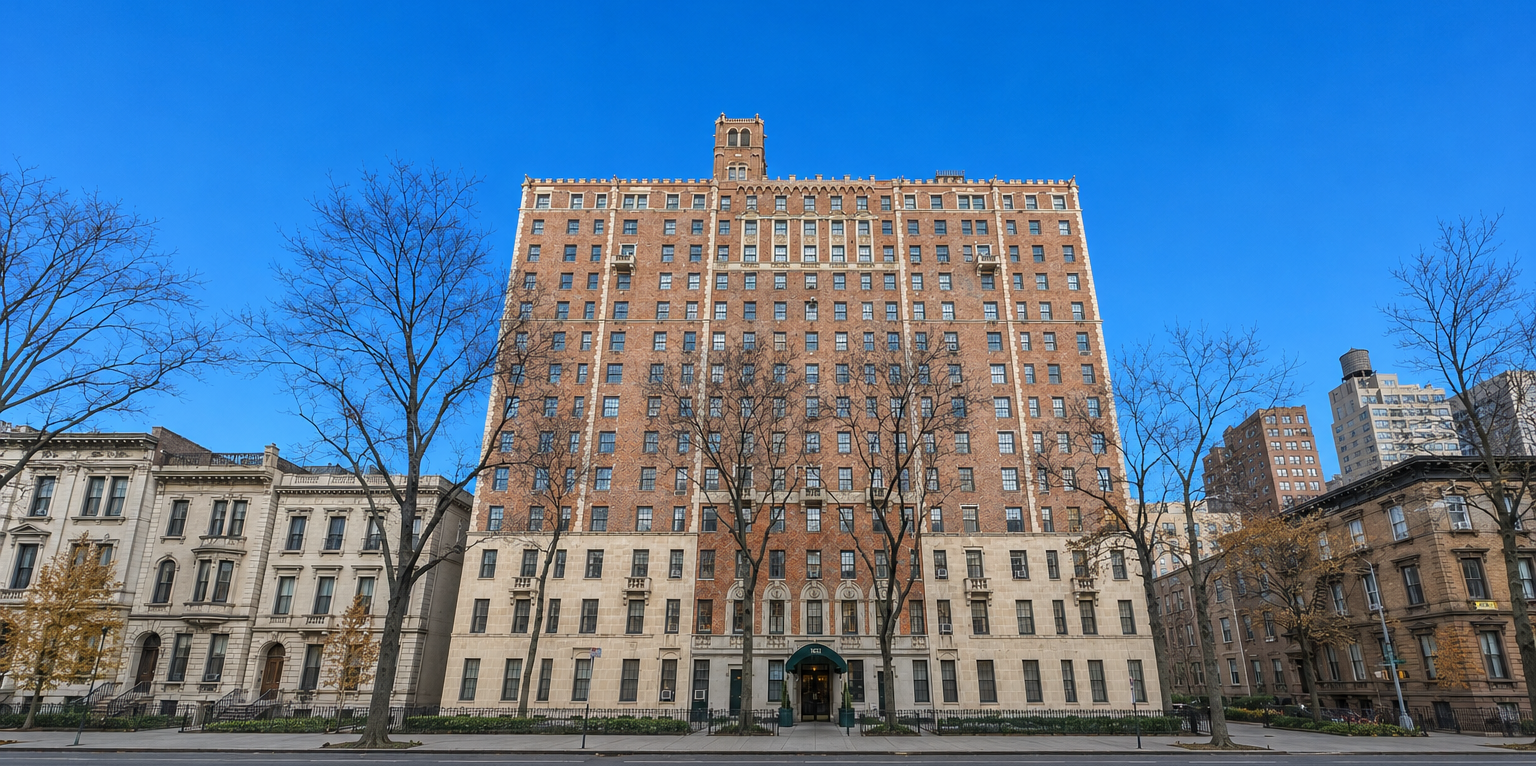
The co-op at 1021 Park Avenue, on the northeast corner of 85th Street, was designed by Rosario Candela in 1929. Known for its dramatic neo-Gothic façade, complete with gargoyles, heraldic shields, and a crenellated parapet crowning the penthouse, the building is a distinctive work in Candela’s Park Avenue portfolio.
Its unusual L-shaped site is due to the efforts of Amos R.E. Pinchot, a Yale-educated lawyer from a prominent family, who purchased two brownstones on the corner in 1905. At the time, Park Avenue was beginning to evolve. Once the railroad tracks that ran down the center of the avenue were electrified and buried in the early twentieth century, the boulevard quickly emerged as one of Manhattan’s most promising residential addresses. Pinchot replaced the brownstones with a restrained Renaissance-style townhouse designed by Hunt & Hunt.
Like many wealthy homeowners, Pinchot sought to control development around his residence. He purchased neighboring properties and sold them with restrictive covenants, preserving a low-rise enclave along the block. That arrangement changed after Pinchot sold the house in 1918. The new owner, Edward Stettinius of J. P. Morgan, expanded the property with additional parcels along 85th Street, creating the irregular site that ultimately attracted developer Anthony Campagna. By the late 1920s Park Avenue had firmly established itself as one of the city’s most prestigious addresses, and Campagna commissioned Rosario Candela to design a co-op for the L-shaped plot.
Candela embraced the site’s quirks. Elaborate red-brick and stone façades face Park Avenue and 85th Street, while lighter brick in the rear reflects additional sunlight into the apartments. The layouts follow Candela’s hallmark planning, with generously scaled rooms arranged in both simplex and duplex configurations. The cooperative opened in 1929 and was quickly successful, with more than half the apartments sold within five weeks.
The building remains one of the Upper East Side’s distinguished pre-war addresses. A 2002 façade restoration carefully rebuilt deteriorated stonework and recreated several damaged gargoyles, preserving the Gothic ornament that gives the building its distinctive character. Inside, many apartments retain Candela’s classic features: high ceilings, spacious galleries, wood-burning fireplaces, and large formal rooms designed for entertaining.
Residents benefit from full-service staffing, private storage, and an exercise center, while the location places Central Park and the museums of Fifth Avenue just blocks away. The building is also zoned for P.S. 6, one of the Upper East Side’s most sought-after public schools as well as close proximity to most of the elite private schools clustered on the Upper East Side, making it especially attractive for families.
1021 Park Avenue stands as both a testament to Candela’s mastery of luxury apartment planning—and to the ironic fact that the building owes its unusual shape to a homeowner who once tried to keep apartment houses away entirely.
Click here to view 1021 Park Avenue, #14C
More About Us:
MetroHistory is pleased to offer its services to Brown Harris Stevens brokers working with pre-war buildings. Founded in 1975 by the late architectural historian and New York Times columnist Christopher Gray, MetroHistory has long been recognized as New York City’s premier specialist in building research and document recovery.
Contact:
212-799-0520
Problems We Solve
- Help buyers make renovation decisions with historic blueprints: When clients want to blow out the wall between the living and dining rooms, we will find the blueprints that actually tell them what they need to know: where the beams, columns, and risers are.
- Help broker marketing historic listings: Add credibility and historic gravitas to your promotional material with original drawings, old photographs, and property history.
- Offer historic photographs as unique gifts: There is no more perfect gift for the proud new owner of a pre-war apartment than a historic photograph or drawing elegantly framed.
- Commemorate history with building reports for co-op centennial celebrations: For their upcoming centennials, boards of pre-war apartment buildings can engage our services to learn more about the history of their buildings and prepare for their next hundred years.
What We Offer
- Drawing Recovery: Locating original architectural, structural, and mechanical drawings.
- Historic Photographs: Access to a collection of 40,000 negatives and 18,000 photographs.
Building Reports: Synthesis of the literature review into a compelling story. Can be targeted for more specialized technical and legal needs.
Click here to learn more about the Office for Metropolitan History
Leave a Reply