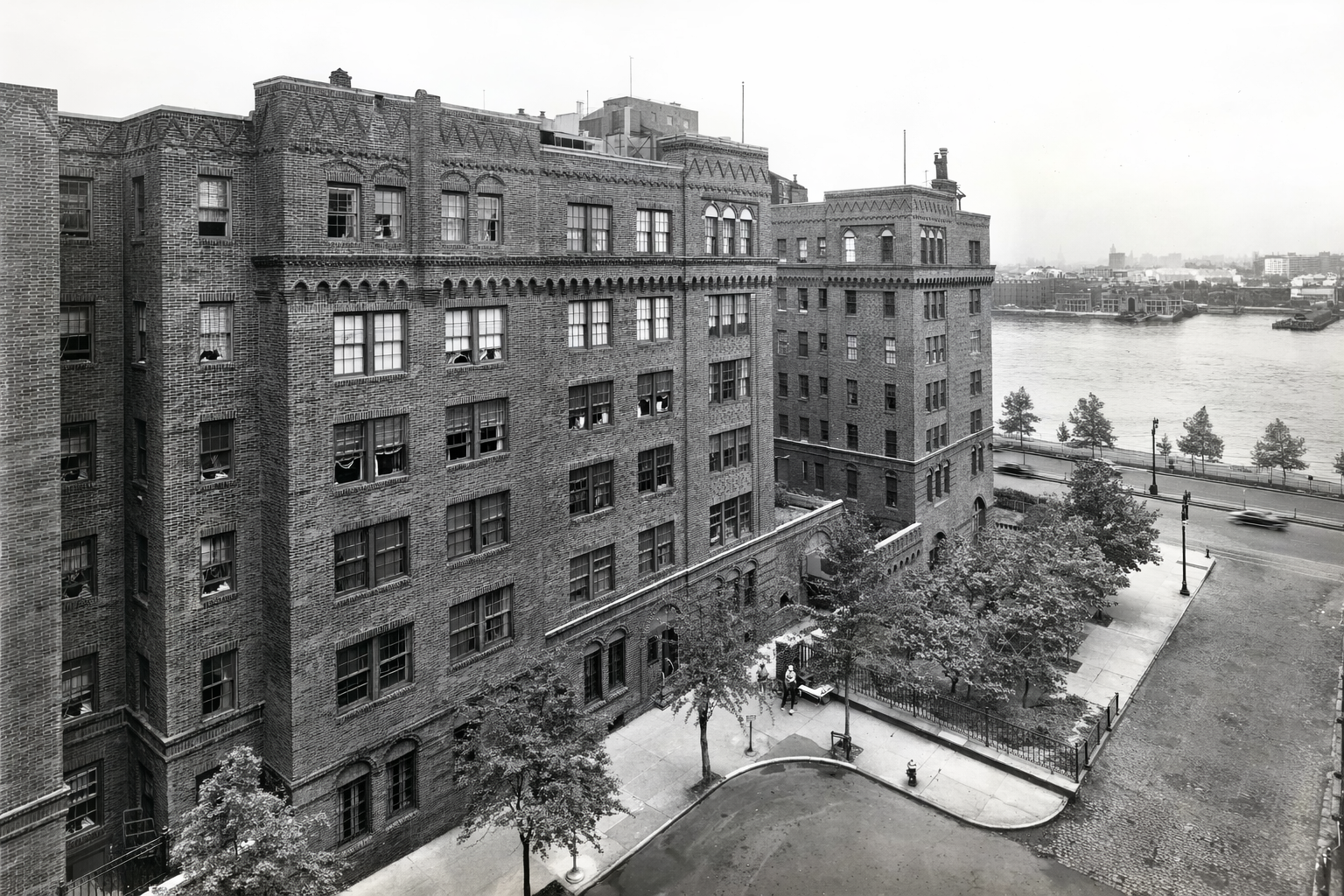
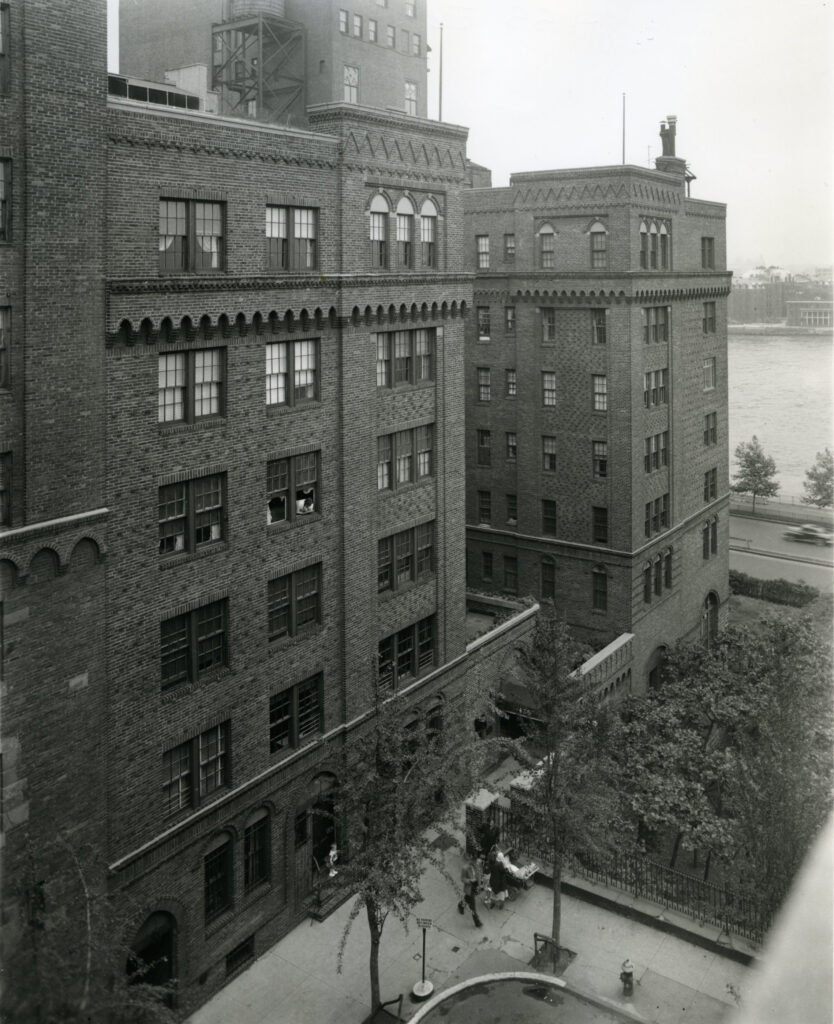
1950 photograph of Beekman Terrace at 455 East 51st Street, from the collection of the Office for Metropolitan History
In 1925, Beekman Terrace, at 455 East 51st Street, was the first luxury apartment house to discover the neglected East River waterfront.
Earlier in the 1920s, New Yorkers began fixing up the old brownstones on Beekman Place. But the biggest change took place in 1924 when Joseph B. Thomas bought the plot at the foot of East 51st Street on the north side, then a collection of wooden industrial buildings. Thomas, born in Boston, had admired Fenway Court, the Venetian-style building in his hometown that is now the Isabella Stewart Gardner Museum.
On the 51st Street plot, Thomas had the architects Treanor & Fatio design a six-story apartment house of Venetian design overlooking the water. The principal river traffic at the time was coal barges and tugboats, but in 1924 the Real Estate Record and Guide praised the anticipated Beekman Terrace, noting that ‘‘the absence of gondolas alone prevents a full conception of the Italian atmosphere,’’ adding that ‘‘a profusion of trees and other planting will make the river bank at this point a garden spot.’’ Early advertisements for the apartments promised private jitney service.
The irregular brick facade is decorated with terra cotta plaques showing the lion, the symbol of Venice’s patron, St. Mark, and maritime symbols recalling Venice’s days as a trading empire. Continuing the Venetian conceit, Thomas’s wife, the muralist Clara Fargo Thomas, wrote that New Yorkers were ‘‘only just beginning to realize what our waterfronts might mean to us,’’ adding that they provided ‘‘an opportunity for the wealth of our present merchant and banker princes to beautify their city.’’
The $600,000 co-op, with about 45 apartments, was completed in 1925. The earliest shareholders included Harold Pulsifer, the poet and editor of Outlook magazine, and Charles Poore, book reviewer for the New York Times. Later residents include historian Arthur M. Schlesinger, Jr., whose work focused on American liberal politicians like Franklin D. Roosevelt and John F. Kennedy. His three-bedroom A-line apartment’s balcony overlooks the East River and its Drive (renamed after one of his research subjects, FDR, in 1945). It was listed at $1,995,000 by Brown Harris Stevens last year.
More About Us: The Office for Metropolitan History (MetroHistory) is pleased to offer its services to Brown Harris Stevens brokers working with pre-war buildings. Founded in 1975 by the late architectural historian and New York Times columnist Christopher Gray, MetroHistory has long been recognized as New York City’s premier specialist in building research and document recovery. For research inquiries, please reach out directly to Sam Hightower, Director, Research@MetroHistory.com, (212) 799-0520.
Services Available
- Drawing Recovery: Locating original architectural, structural, and mechanical drawings.
- Historic Photographs: Access to a collection of 40,000 negatives and 18,000 photographs.
- Literature Review: Comprehensive review of architectural periodicals, historic newspapers, brochures, deeds, and other archival material.
- Building Reports: Synthesis of the literature review into a compelling story. Can be targeted for more specialized technical and legal needs.
When To Call Us
- Renovation Needs: When clients want to blow out the wall between the living and dining rooms, we will find the blueprints that actually tell them what they need to know: where the beams, columns, and risers are.
- Marketing Premier Listings: Add credibility and historic gravitas to your promotional material with original drawings, old photographs, and property history.
- Client Gifts: There is no more perfect gift for the proud new owner of a pre-war apartment than a historic photograph or drawing elegantly framed.
- Centennial Celebrations: For their upcoming centennials, boards of pre-war apartment buildings can engage our services to learn more about the history of their buildings and prepare for their next hundred years.
Click here to learn more about the Office for Metropolitan History
Leave a Reply